Category Archives: Uncategorized

Zenryoku


Leave a comment

Filed under Uncategorized

RIKI


My mother gave me my middle name "Riki", which is the same kanji as "chikara", meaning power or strength.

Leave a comment

Filed under Uncategorized

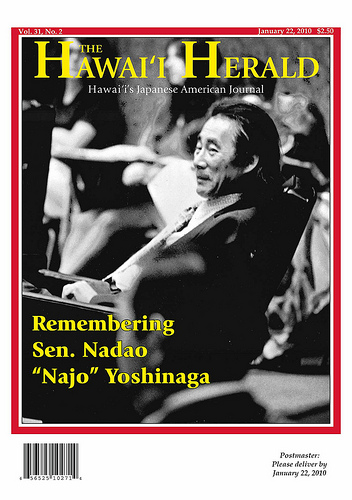
Hawaii Herald Article on Senator Nadao “Najo” Yoshinaga


As I campaign across the State of Hawaii, I have had the opportunity to greet many of the World War II generation, now in their golden years.  I am touched when I hear a senior say, “Good luck” or once in awhile a senior who is American of Japanese Ancestry would say, “Ganbatte” (also means good luck).  I dedicate my politcal career and this race for Lieutenant Governor of Hawaii to them for all the sacrifice they have done to make our lives better. I think of my grandparents and all of those of this generation who have passed away.

I think of one of the leaders of this great generation Senator Nadao “Najo” Yoshinaga who I wrote an article about for the Hawaii Herald’s January, 22, 2010 issue.  It was a dream come true for me to be mentored by him.  I will forever cherish his friendship.  Below is my article about him.

Hawaii Herald

Article on Senator Nadao “Najo” Yoshinaga

By Representative Jon Riki Karamatsu

Monday, January 11, 2010

Since I was young, I looked up to the 100th Infantry Battalion and 442nd Regimental Combat Team, elected officials of the 1954 Democratic Revolution, and the entire Nisei generation (second generation of Americans of Japanese ancestry) because of the sacrifices they did to make the world better for us.  I had hoped someone from this great generation would guide me in the world of politics as I continued to pursuit my dream of a more peaceful world with social and economic stability.  Thus, my friendship with Senator Nadao “Najo” Yoshinaga is a dream come true for me because he was all three, a Nisei, member of the 442nd Regimental Combat Team, and legislator of the 1954 Democratic Revolution.

I met Senator Yoshinaga in January of 2002 while I was working for Senator Carol Fukunaga.  On one of his many visits to Senator Fukunaga, I showed a picture of him with his company within the 442nd Regimental Combat Team, which I printed from the Internet.  He was surprised and impressed that I researched him.  We quickly became friends.  I told him my political platform and my campaign strategy, and how I was going to run for state elected office in the 2002 elections.  I also found out my grandfather Maurice Karamatsu was friends with him when my grandfather was Vice President of Duty Free Shoppers.

I was very impressed with Senator Yoshinaga’s life experiences.  He graduated from Maui High School and the University of Hawaii at Manoa where he attained his Bachelor of Arts degree.  He volunteered for the United States Army and served in the 442nd Regimental Combat Team.  After the war, Senator Yoshinaga decided to apply his GI Bill benefits to study law at DePaul University where he attained his Juris Doctorate degree.  He returned to work for the law firm of Bouslog and Symonds in Honolulu, and then in Maui, which was known for its defense of the ILWU or International Longshore and Warehouse Union.  Senator Yoshinaga was elected into the House of Representatives of the Territory of Hawaii in the historic 1954 Democratic revolution.  In 1959, he was elected into the Senate of the State of Hawaii where he served until retiring in 1974.  Senator Yoshinaga was the chairman of the influential Senate Labor Committee and Ways & Means Committee.

What I liked a lot about Senator Yoshinaga was his genuine love for Hawaii and you could feel his sincerity by the amount of positive energy that radiated from him when he talked about issues he felt were important to make Hawaii great.  He played a key role in eliminating the discriminatory laws in Hawaii, ahead of the rest of the United States; creating the Prepaid Health Care program, which resulted in Hawaii having one of the best, if not the best health insurance coverage in the nation; establishing the Art in Public Places program that supports our local artists; starting the Commission on the Status of Women that advocates on issues important to women; and appropriating funds for numerous capital improvement projects throughout the state. 

I launched my campaign for the State House seat that represents Waipahu in April of 2002.  I had my first fundraiser at Alan Wong’s Pineapple Room.  Senator Yoshinaga and his wife Mieko were the first ones there.  They must have arrived a half an hour early.  I won the election.

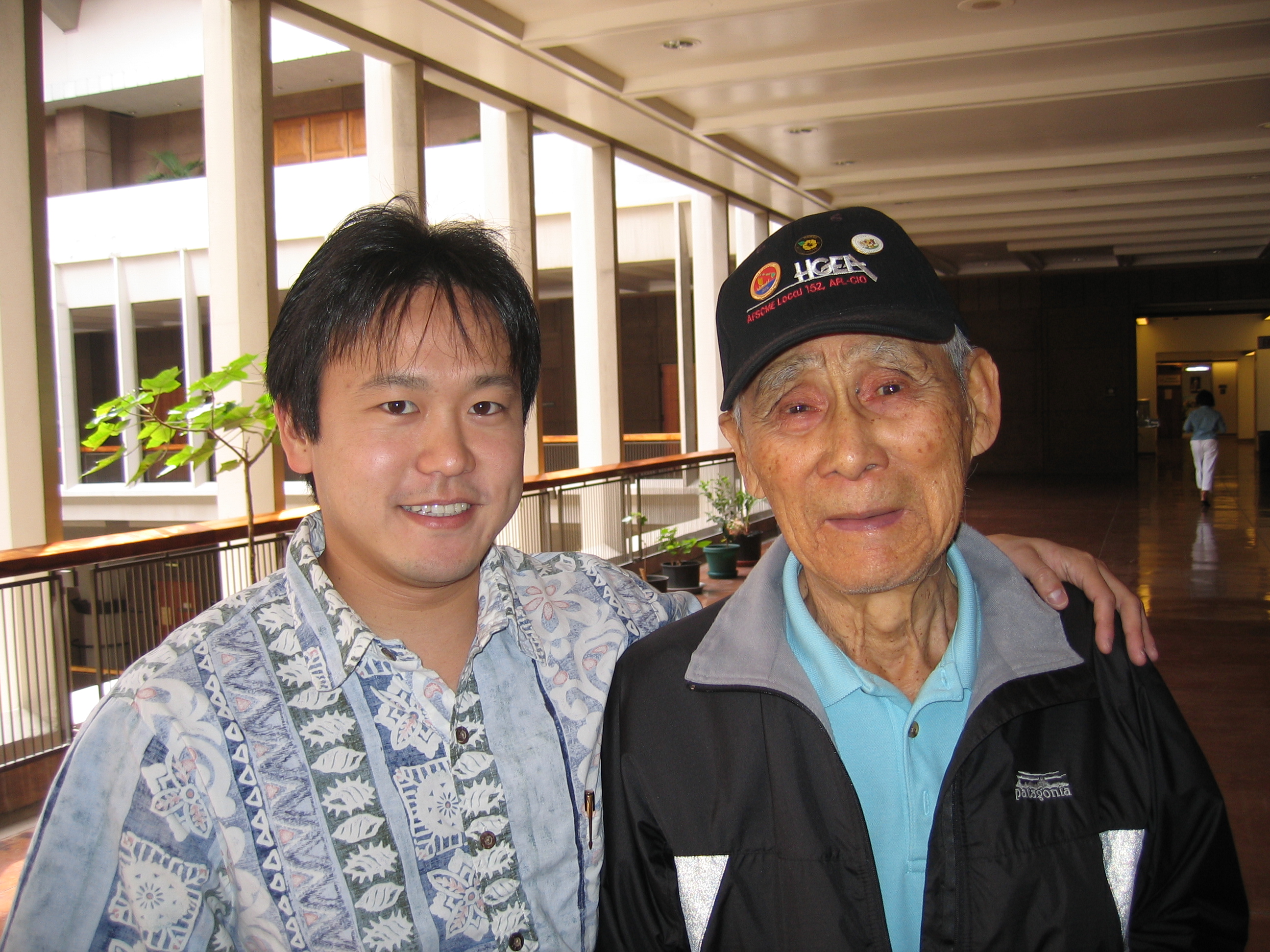
As soon as I got into my capitol office, Senator Yoshinaga would visit me regularly.  As a politician, I must have had thousands of meetings in my office.  Sometimes Senator Yoshinaga would wait in my main office and people would constantly come in and out.  As each person or group entered, I would introduce them to him.  I remember having him sit in a meeting with an advocate.  He would quietly listen, and the advocate would talk, then look at me and look at him, waiting for a reaction.  It was funny to see the advocate’s face.

I have many memories of Senator Yoshinaga, but one of my favorites is when he brought the CEO of Enterprise Honolulu, Mike Fitzgerald, to my office to strategize on ways to strengthen Hawaii’s economy on May 28, 2008.  Senator Yoshinaga, Mr. Fitzgerald, my office manager Baron Gushiken, and I discussed Hawaii’s economic climate of that time, some of the legislation I introduced in the past, and ideas I had for the future to help better Hawaii’s economy.  We talked about renewable energy, technology, film, digital media, long-term care, workforce development, education, mass transit, and agriculture.  At the end of the meeting, Senator Yoshinaga told me, “This was a good meeting.”  I looked at him and smiled, “Yup, this was a good meeting.”  He looked so happy.  

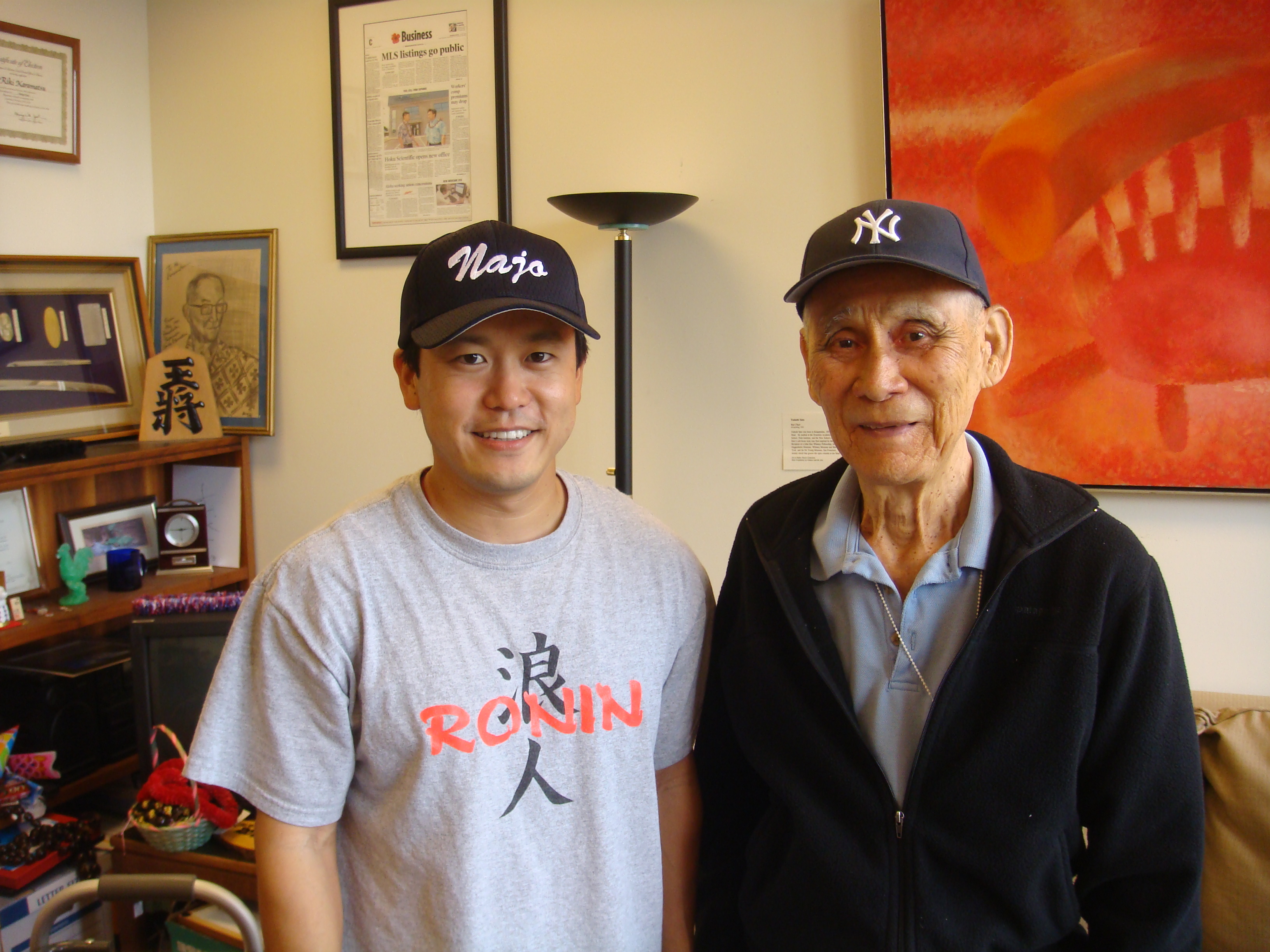
I enjoyed all the birthday parties planned by a handful of us business, community, and political leaders.  His 89th birthday was on August, 8, 2008 or 08/08/08.  I remember him telling me, “People tell me this is really good, to have my birthday on 08/08/08.”  We celebrated his birthday a little belated at his senior living facility’s party room.  Every birthday of his was a who’s who of Hawaii.  Someone told me to sit by Senator Yoshinaga.  Governor John Waihe’e, who I admire and became friends with through his children John and Jennifer, jokingly said, “Whoa Jon Riki.  You have the audacity to sit right next to Najo.”  Everyone laughed as I smiled, a little embarrassed.  We all got a dark blue “Najo” baseball cap.  Senator Yoshinaga looked extremely happy.

On March 18, 2009, there was a joint House and Senate legislative session on the House floor honoring state elected officials of 1959 in conjunction with honoring our 50th anniversary of statehood.  Senator Shan Tsutsui of Maui and I made a speech about honoree Senator Yoshinaga.

Last year on August 10, 2009, we celebrated Senator Yoshinaga’s 90th birthday at the Hawaii Technology Development Corporation, which is fitting since he always talks about how research is important for Hawaii’s future.  It would be the last time for many of his political friends and protégés to be with him as a big group in the same room.

On December 23, 2009, I had my last talk with Senator Yoshinaga at my capitol office.  My campaign seemed to be on his mind.  He made a suggestion that I will follow through on the best I can.  In the past, whenever we say goodbye at the State Capitol, Senator Yoshinaga would tell me, “I may not see you again,” implying that he could pass away anytime.  However, I don’t recall him saying this at all in the months leading to his passing.

On December 29, 2009, I wore my “Najo” baseball cap as I did my errands.  I was worried because I knew he had a stroke earlier that weekend and was in the hospital.  That afternoon, I got a phone call from Baron Gushiken that Senator Yoshinaga had passed away.  For some reason, his death didn’t sink in as something that really happened.

A couple of days later, I talked to Senator Yoshinaga’s daughter Susan.  She told me that the week before I saw Senator Yoshinaga, he had wanted to visit me but Baron Gushiken who helps him get around the state capitol was busy.  Usually, Senator Yoshinaga doesn’t complain, but this time he told her, “How come?  I want to see Jon Riki Karamatsu.  I can go by myself.”  She told him about the schedule conflict but that he could go to the state capitol later.  After hearing this, I was really touched.  I am so glad I got to see him on December 23, 2009 at my office.  I am sure Baron feels the same way.

In my years knowing Senator Yoshinaga, he never talked about his military experience in World War II with his service in the 442nd Regimental Combat Team at the European front.  I believe those memories were too painful.  Rather, he found joy in doing positive things for Hawaii through politics.  I learned from his friends that he was one of the first politicians to oppose the United States’ involvement in the Vietnam War and it took a toll on his family.  Similarly, I opposed our country’s wars in the Middle East region. When I got involved with Peace Day Hawaii, he was pleased.  I believe he liked that I had peace as one of my long term goals for the human race.

Senator Yoshinaga was a visionary in his time as an elected official and when he left public office, he continued to dream for Hawaii.  Coincidentally, a lot of the work he started, I seem to have picked up where he left off.  He was always talking to me about economic development, technology, and Enterprise Honolulu.  Sometime in 2005, I asked him on why he was so interested in economic development?  He replied, “I had to adjust to the times.”  In his twenty years in elected politics, he accomplished a lot to help labor because of the inequity between labor and management that occurred during a good portion of his life.  However, near the end of his career, he began to work on more business and economic issues.  In regards to economic development, Senator Yoshinaga told me, “I didn’t do enough.  By the time I started, it was too late, my twenty years were up.”  His dream for economic development is also my dream, as it is a big part of my platform, especially in areas such as technology, science, renewable energy, film, digital media, and art.  I have helped the technology, renewable energy and film industries through government-backed special purpose revenue bonds and tax incentives that attracts investments.

Senator Yoshinaga worked hard to eliminate many of Hawaii’s discriminatory laws against minorities, women, and labor.  Equal rights are also very important to me.  Last year, in the 2009 Legislative Session, as chairman of the House Judiciary Committee, I passed the civil union bill out of my committee with a unanimous vote that would allow same-sex couples to enter a contract like that of married couples, thus expanding the rights for same-sex couples to be equal to that of heterosexual couples.  This bill passed the entire House but stalled in the Senate.  After the historic vote in my House Judiciary Committee, Senator Yoshinaga visited me at my office and said, “Times are changing.” 

Senator Yoshinaga had the foresight to create the Hawaii Prepaid Health Care Act that requires employers to provide health insurance to their employees who work twenty hours or more a week for four consecutive weeks.  Employees must minimally maintain a twenty-hour work week to remain eligible.  This law has helped Hawaii to have most of its population covered by health insurance.  With a huge part of our population entering their golden years, we face a growing challenge in addressing long term-care demands.  I want to allocate all food and drug general excise taxes to a long-term care insurance program to protect our disproportionately large aging population.

In one of our many conversations, Senator Yoshinaga laughed about how he inserted language in a bill to create the Commission on the Status of Women, which looks out for interests that are important to women.  Coincidentally, in the 2003 Legislative Session, I helped organize legislators to stop Governor Linda Lingle from eliminating the Commission on the Status of Women.  In my career, I created laws that highly impact women such as including in our sexual assault laws “the use of a substance to subject one to sexual penetration” to address the use of rape drugs, and expanding the definition of “harassment” and “harassment by stalking” to include contact through electronic communications.  I have also supported state funding to organizations that help survivors of domestic violence and sexual assault.

Senator Yoshinaga started the Hawaii State Foundation on Culture and the Arts and the Art in Public Places program which designated one percent of the construction costs of new buildings for the acquisition of works of art, either by commission or purchase that has helped support many local artists.  I have also been supportive of the arts, especially in film, expanding incentives to encourage more film production here with flexibility to allow small budget productions to participate in order to support our local filmmakers and businesses within the film industry.

As my mentor, Senator Yoshinaga gave me advice but never directed me on what to do.  I think he really wanted me to come up with my own decisions.  His words of advice or comments were often short and straight to the point.  For example, in the 2005 Legislative Session, there was a bill that would give labor more flexibility in their break time, however, employers felt it would hamper business operations and increase costs, especially for small and boutique businesses.  I was trying to find a balance on that issue.  Senator Yoshinaga simply told me, “Balance is important.”

Senator Yoshinaga’s last policy advice to me was clear.  He told me that it is very important that we grow our own food and produce our own energy.  He is absolutely right.  So much of our money leaves the state because we buy imported food and energy.  If we want to become an economic power or at the least, become more self-sustainable, we have to grow our own food and produce our own energy.  I will continue to support our agriculture and renewable energy industries by protecting our valuable agricultural lands and maintaining incentives for farming and renewable energy production.  Lastly, with his appreciation in my effort for peace, I will do all I can to reduce violence in Hawaii and the world. 

Symbolically, Senator Nadao “Najo” Yoshinaga’s death and life was broadcasted in news mediums throughout the State of Hawaii on New Year’s Eve, December 31, 2009 and New Year’s Day, January 1, 2010 as if telling us that he will always be with us in the future.  His work on various laws, programs, buildings, and highways will continue to impact us and many more generations to come.  He will live on through his family, friends and protégés who will continue his legacy.  A true politician never dies and never fades away.  When I close my eyes, I can picture Senator Yoshinaga smiling, and in a loud voice, he says, “Make Hawaii the best place in the world!

2 Comments

Filed under Uncategorized

Farewell to the Hawaii House of Representatives


Representative Jon Riki Karamatsu

Farewell Floor Speech (Jon spoke about half of the speech and inserted the entire speech into the House journal)

Thursday, April 29, 2010

Mr. Speaker, it has been an honor for me to serve in the Hawaii House of Representatives.  My eight years here has been a great experience.  I have learned so much and met so many wonderful people.  To become a politician is a dream come true for me.  In 1996, I set my goals to make Hawaii and the United States a better place, most of which is the foundation of my political platform today.  That year, I also created my logistical plan to run for the Hawaii State Legislature in 2002.  Leading up to 2002, I served as Vice President of the Associated Students of the University of Hawaii at Manoa, participated in community organizations, served on the Pearl City Neighborhood Board, volunteered for political campaigns, and worked for legislators.  After I graduated from the University of Hawaii at Manoa with a B.A. in political science in 1997, I went to Washington State where I graduated from Gonzaga University School of Law in 2001.  I returned back to Hawaii that year and passed the Hawaii State Bar examination and received my law license. 

In 2002, I launched my campaign for the Hawaii House of Representatives, District 41, which encompasses Waipahu and its subdivisions of Waipahu Town, Waikele, Village Park, and Royal Kunia.  I received no endorsements.  One of my opponents was a well-know community leader, and she received most of the union endorsements.  Another opponent, an insurance man, got endorsements from the business trades.  I had the support of my family and my friends, most of which were a bunch of twenty-year-old friends.  These family and friends is still the core of my campaign today.  With only about $13,500, we had a low budget campaign.  I walked my district three times.  Despite the odds that were against us, we won that race.

I was excited to begin my political career in the Hawaii House of Representatives.  Before I met you Mr. Speaker, I had heard about you because of my grandpa Maurice Karamatsu who was really good friends with your father-in-law, Stephen Kotake.  I had heard how my grandpa really liked you because you were humble.  Even with your college degree in education, you worked as a busboy for a restaurant because you were loyal to the company.  As you were my grandpa’s friend, I pledged my loyalty to you.  As soon as I met you, everything felt right. 

When you asked me what committee I wanted to be in.  I responded that I wanted to be in the Economic Development & Business Concerns Committee.  You told me, “No. You should be in Tourism & Culture Committee.  Your grandpa was in tourism.  While at Duty Free, it is your grandpa who helped open the Japan market to Hawaii.”  At that time, the chair of the Tourism & Culture Committee was the representative from Hilo (Representative Jerry L. Chang).  I stumbled here and there as a freshman, but I soon learned from the representative from Hilo.  It was during this time that we divided the tourism marketing contracts by regions of the world instead of one big contract.  I found out that my chair had so many friends not only from Hawaii, but all over the world, especially Taiwan and China.  He was more than a State Representative, but more like that of a United States Senator.  Everybody loved him.  I learned not only how to be a chairman of a committee, but the importance of building friendships.

In one of my early meetings as a freshman legislator, I met the executive director of the Commission of the Status of Women, which was at risk of being eliminated by the newly elected governor.  At the end of the meeting, I committed to help protect the commission from being dissolved.  I organized a letter with the support of the Women’s caucus in the Legislature.  The administration later backed off, thus the commission was saved.  Because of my stance on issues important to women, I was later invited to speak at the Women’s Caucus press conference.  In later years, I introduced bills supported by the caucus.  In 2006, I coordinated a donation drive for the Sex Abuse Treatment Center and got actor Daniel Dae Kim to volunteer and the television show “Lost” to donate their pilot show script that was auctioned off for the cause.

In 2003, I introduced a bill to give local filmmakers a discount at state film facilities.  The state film office decided to give these discounts administratively, and thus, legislative action was no longer needed.  In the second year of my freshman term, I passed a law that required the department of Agriculture to authenticate Ni’ihau shell leis to empower Hawaii Ni’ihau shell lei makers and protect consumers from fraudulent sales using the Ni’ihau shell branding.  I introduced a resolution asking the Department of Accounting and General Services to conduct a study on the cost of maintaining Aloha Stadium versus building a new stadium.  They concluded that renovating the stadium was more cost effective than building a new one.  Also that year, I took an active role to help pass a bill that helped the airport concessionaires in re-negotiating their leases with the state because they were still suffering from the aftermath of the 9/11 attacks. 

However, I have to admit that I made a freshman mistake when I passed the bill mandating ethics training for state government officials.  Everyone, including the governor and her cabinet had to take this course.  Some government officials were a little irritated.  Looking back, I believe this would be better placed in our House rules.  This year I joked with staff from the Ethics Commission that we should repeal the law and put it into House rules.  They laughed and quietly agreed because that law forces them to work hard at the beginning of every first year of the biennium.   Members, you are welcome to repeal that law.

The 2004 elections were intense.  I was targeted by the Republican Party with the Governor and Lieutenant Governor walking door-to-door in my community with their respective entourages.  I won re-election to the Hawaii House of Representatives.

In 2005, my biggest legislative idea was on creating a Kindergarten to twelfth grade science and technology magnet school to prepare our children for Hawaii’s knowledge-based economy.  Although my bill did not pass, the following year, I was pleased when the governor made innovation in education a priority and we passed a bill that expanded learning in science, technology, engineering, and math for our public schools.  That year, as a Finance Committee member, I was assigned to many conference committees.  I was approached by the representative from upcountry Maui (Representative Kyle Yamashita) and the former Representative from West Kauai, Bertha Kawakami to help them on bills that would be harmful towards business.  I helped both of them to address their concerns but I took a lot of heat from certain chairs.  There was also miscommunication with a senator on another conference.  I got yelled at by all three chairs and heard the finance chair of that time was upset.  I went to Representative Bob Nakasone’s office where I hung out often.  I went out to the balcony and expressed my frustration.  Mr. Speaker, you and Senate President “Bobby” Bunda were sitting on lawn chairs in the dark further down.  You told me to come by where you were and I sat by you on the concrete.  Not too long later, Representative Bob Nakasone came out of his office and sat by me to the right.  With all the pressure, I broke down crying explaining that I was just trying to find balance on bills for our dear friends Representative Bertha Kawakami and the representative from upcountry Maui.  Your words of advice and Representative Nakasone’s presence brought me comfort. 

Mr. Speaker time and time again, you have helped me in some of my toughest challenges.  I remember in 2004, with the support of my closest colleagues, we voted against the majority on a bill that would have negatively impacted research on state land.  You told me, “The State probably didn’t know what happened tonight, but tonight when you go home, you will see how peaceful it is.”

After the 2005 Legislative Session, Representative Ken Hiraki decided to leave the House of Representatives to take a position with Hawaiian Telcom, thus leaving his chairmanship of the Consumer Protection and Commerce Committee open.  Mr. Speaker, with your appointment of the Representative from Puna (Representative Bob Herkes) to that chairmanship, that left his former post, the chairmanship of the Economic Development & Business Concerns Committee vacant.  I was extremely honored when you gave that position to me.  It was a dream committee because I love that subject matter and it is one of my biggest goals to make Hawaii an economic power per capita.

In 2006, as Chair of the Economic Development & Business Concerns Committee, I went full blast ahead.  I introduced a bill to give tax credits for film production in Hawaii, 15% on Oahu, and 20% on neighbor islands to make Hawaii competitive in the world to attract film projects, especially the huge Hollywood blockbuster movies.  Together with the Representative from Hilo (Representative Jerry L. Chang), who was still Chair of the Tourism & Culture Committee, and the Senator from Makiki, my friend and former boss (Senator Carol Fukunaga), we passed the companion bill into law.  That legislative session, I also passed a bill that expanded the Small Business Innovation Research Grants (SBIR) and Small Business Technology Transfer Research Grants (STTR) to maximize federal matching dollars to help Hawaii’s start-up technology businesses.  I also passed a bill floating $10 million in special purpose revenue bonds for Hoku Scientific, Inc., a local technology and renewable energy company to help build their facility in Kapolei.  Further, I had a bill that included in the sexual assault law, “the use of a substance in subjecting one to a sexual assault” to address the problems of date rape drugs.  My bill was incorporated into an omnibus criminal bill that was passed into law.

That year, as a result of a request by a number of neighbor island representatives, Mr. Speaker, you asked me to help save the County of Hawaii from a looming lawsuit regarding the Hokulia development on marginal agricultural land.  There was a land use bill in my committee carried over from the previous year.  I placed an amendment inserting language that would grandfather the Hokulia development, thus protecting that project from the suit.  Not too long later, the lawsuit was settled.

Mr. Speaker, you came up with the $100 million innovation fund bill, one of the biggest bills of 2006.  This fund was to be used for investments and grants for Hawaii science and technology companies.  You told me to go with it.  Returns in investment would go back into the fund, and I tweaked the bill so that it would always have a corpus to collect interest to help replenish the fund.  During conference, a little before midnight, the deadline for all conference bills, you called me to go to conference room 309.  I was in my office enjoying the evening with my friends.  I told everyone, I had to go.  It was show time.  My staff and a number of my friends followed me out of the office with a good friend of mine filming with a video camera.  We joined my co-chair from the Finance Committee, the Representative from upcountry Maui (Representative Kyle Yamashita).  Our entourage entered room 309, which was extremely packed with so many people overflowing outside up to the railings.  For new members, there was much more people than what you have seen in the past couple of years.  Our counterpart was then Ways & Means Chair, the Senator from Manoa (Senator Brian Taniguchi) and his co-chair was the Senator from Makiki (Senator Carol Fukunaga).  I threw over the House proposal.  Later, the senator threw over a different proposal.  I looked at the senate’s proposal, and then looked at my friend, the Representative from Upcountry Maui.  We had that look, like what is this?  I called a recess.  My co-chair and I exited the back door.  We talked a little in the hallway with little time before the midnight deadline.  I said, “Let’s talk to Pono,” whose office was only feet away.  After all, he was a former Ways and Means staffer and just plain brilliant.  When we entered his office, the Representative from Enchanted Lake and Maunawili (Representative Pono Chong) was sitting on the carpet of his office fixing or doing something.  We looked at him on the ground.  He looked up at us with that surprised look, like what in the world are you guys doing here?  I told him that we’re in conference.   I think he replied sarcastically like, “Uh yeah.”  I told him you need to look at this CD1 and calculate the numbers as quick as you can.  In what seemed like seconds, the representative from Maunawili, Kaneohe explained that the numbers were smaller than what was agreed by Speaker and Senate President.  I grabbed the CD1 and together with the Representative from Upcountry Maui, we went back into the conference room.  The Ways and Means Chair asked us to agree to his proposal.  In front of the crowd trying to listen what we were saying, I told him, “No, we are sticking to the House position.”  Time was ticking; apparently this bill was tied to the streamline use and sales tax bill.  With only minutes left on the clock, the Ways and Means chair, a little disturbed, agreed to go with the House’s position.  We passed the Innovation Fund as well as the streamline sales and use tax bill.  On final reading, the House killed the streamline sales and use tax bill.  In revenge, the Senate killed our innovation fund bill.  Usually when the Senate finished earlier, which is always the case, they would come to the House, and we would recess so we could shake their hands.  However, this time, when the Senate came over they couldn’t get in because Mr. Speaker, you had sergeant-at-arms lock all the House doors.  I had heard that some of the senators were knocking on the door.  Mr. Speaker, I am still not sure if you were upset because our innovation fund bill died or if there were problems with some other bill?  Anyways, looking back, it was a little funny.

Mr. Speaker, at the 2006 Democratic Party of Hawaii Convention, I presented you my typed-out strategy to run for statewide office in 2010.  The only other elected official I shared this plan with was Representative Bob Nakasone.  On the Saturday of that convention you hosted a number of our colleagues to a dinner at a Chinese Restaurant.  We returned back to the convention to socialize the convention delegates.  My friend Wayne Yagi was my driver that night.  As we were leaving, I realized I didn’t have the strategy with me.  I told Wayne that I forgot something important.  He told me that I could look for it tomorrow.  I panicked, “You don’t understand, if someone finds my papers, they will know my whole political strategy for the 2010 elections.”   My strategy was detailed on everything I had to do, month by month.  The next morning I went to the convention really tired.  Mr. Speaker, you and Senate President Bunda was chairing the convention at the time.  You called a recess, walked down the stage and down the long aisle.  You walked right up to me and pulled some papers from your back pocket and told me, “You forgot something.”  It was my strategy for my statewide 2010 campaign. 

For 2007, Mr. Speaker you asked me to be your Vice Speaker of the House.  After much thought, I took your offer and joined your leadership team.  That year, I passed a bill floating $10 million in special purpose revenue bonds for Sopogy, Inc. to develop a solar farm at the Natural Energy Laboratory of Hawaii in Kona, Hawaii.  This project is currently under construction.  My memorable bill was working with the Hongwanji’s Young Buddhist Association in passing a law recognizing September 21 of each year as Peace Day to promote peace programs, improve international relations, and increase educational awareness of peace.  I have chaired the Peace Day Hawaii event for the past three years.

On October 16, 2007, I crashed my car, called the police, and was charged with DUI.  As a result, I stepped down as Vice Speaker of the House.  However, Mr. Speaker, you gave me the opportunity to be Vice Chairman under the Representative of Haiku Valley and Kaneohe, the Chairman of the Water, Land, and Ocean Resources, & Hawaiian Affairs Committee(Representative Ken Ito) who I would eventually declare as the founder of Itoism because of his deep philosophical thought.  As his disciple, I was ready to take on a new realm of laws. 

In 2008, the Representative from Kaneohe (Representative Ken Ito) and I drew our swords and charged.  Together with the other Representative from Hilo (Representative Clift Tsuji), the fighter of Coqui frogs, we passed a monumental bill that created incentives for the important agricultural lands classification, a 1978 constitutional mandate that had been unresolved for thirty years. 

We charged into another battle to resolve another 30-year issue in regards to the 1978 constitutional mandate of funding 20% of ceded lands revenues to the Office of Hawaiian Affairs.  The Office of Hawaiian Affairs had been suing the State of Hawaii for years saying they are not receiving their share of funds.  We moved a bill requiring the State to convey certain lands and make additional payments to the Office of Hawaiian Affairs; however, the Senate did not move on it when it reached them.  Nonetheless, it was a good attempt to resolve the dispute.

Further, in 2008, I passed a bill that required the government to better maintain records to prevent identity theft as was requested by the Identity Theft Task Force that I sat on for two years with the Senator from Makiki (Senator Carol Fukunaga).  In addition, I passed a law prohibiting a towing company from charging the owner of a vehicle hooked up for towing if the owner of the vehicle appears on the scene.  Further, I helped Sopogy, Inc. again by passing a bill floating $35 million in special purpose revenue bonds to help it with the development of a solar farm on Oahu.  Lastly, I was able to get a $1 million appropriation inserted into the budget bill for beach restoration in resort areas that matches private funds.

In the 2008 elections, I was at a low.  I had a talk with Representative Bob Nakasone in his office.  As usual, he asked, “So how’s everything?”  I told him everything was okay.  He told me, “Don’t forget your dream.”  I looked at him and said, “Rep. Nakasone, I don’t know.  I can’t see past tomorrow.”  He stated again, “Jon, don’t forget your dream.”  I looked up to him, smiled, and nodded.  Those were the last words he told me.  He was hardly in his office and I was campaigning like crazy, so we didn’t get a chance to talk to each other again.  Representative Nakasone passed away on December 7, 2008. 

My opponents attacked me on everything including my DUI.  With the help of Calvin Azama, policy adviser of Speaker (Calvin K.Y. Say), who walked my district with me three times, I won the primary election and in the general election, I had the most votes in my career.

Mr. Speaker, I entered 2009, honored to be your new Judiciary Committee Chairman.  After going through some tough challenges, I was back a thousand times stronger.  I introduced a package of bills to help retain doctors and lower medical liability insurance.  I drafted the health information technology bill in hopes to bring all parties together to prepare Hawaii for $10 to $1 federal matching funds available in 2011 that will interconnect the computer networks of all of Hawaii’s health providers.  I created a bill that would protect our prime agricultural lands.  In my goal to protect our public from harm, I passed legislation that created the criminal impersonation law and updated our harassment and stalking laws to include electronic communication.  I also passed legislation protecting our pet animals by allowing a temporary restraining order be extended to pet animals and ensuring our pet animals are humanely treated when placed in confinement.  Further, I changed the joint and several liability tort laws to help our small professional design companies.

Moreover, I enjoyed working with the Representative from Wahiawa, Chairman of the Finance Committee (Representative Marcus Oshiro) to ensure there was enough funding for the Judiciary Branch despite the bad economy.

This year, 2010, I continued serving as your Judiciary Committee Chairman.  With the economy continuing to be in bad shape, I searched for any cost savings for the State in the Judiciary budget besides cutting costs to programs and positions.  I focused on ensuring there is enough funding for our specialty courts, which has been proven successful in turning individuals’ lives around to be productive citizens rather than abusing illegal drugs or committing crimes, which not only betters our society but saves the state a lot of money.

I also worked to pass the campaign finance bill that reorganizes the existing campaign finance provisions in the campaign finance laws, by dividing long sections into shorter sections with clear titles for quick reference and group laws on one subject together, among other things, and with a few substantive changes such as an inclusion of a new section to provide for transparency and to indicate that the campaign finance laws should be construed to support transparency.

I passed a bill authorizing certified shorthand reporters to administer oaths and affirmations in the performance of their duties as deposition officers without the necessity of being notaries public, which will help make the process faster for this important service in our legal system. 

Another measure I passed revised laws prohibiting the cruel treatment of pet animals by specifying the standards of care that an owner must provide a pet animal, including the type of pet enclosure and under what conditions and when veterinary care must be provided but without affecting animals that are raised for food.

In my term as Judiciary Committee Chairman, there were a number of issues that I worked on that did not pass but went very far in the Legislature, some on the brink of passage.  Although such legislation may not have passed, it stirred discussion throughout the State of Hawaii.  After all, the Legislature is where important issues get an opportunity to at least be discussed.

My career in the Hawaii House of Representatives has been a good one.  I thank the people of Waipahu for giving me the honor to represent them.

Mr. Speaker, I want to thank you for all your love and support.  You have been a great mentor for me.  I want to thank my other mentors, the Representative from Hilo and our Higher Education Chair (Representative Jerry L. Chang) and the late Representative Bob Nakasone.  I have sincere appreciation for my dear friends who provided support for me, the Representative from Kaneohe (Representative Ken Ito) who I shared many humorous conversations, the other Representative from Hilo (Representative Clift Tsuji) who I had many wonderful conversations, and the Representative from West Kauai (Representative Roland Sagum) who I enjoyed hanging out with, which helped me to relieve some of the stress I was going through.  I sincerely appreciate all of your unconditional friendship. 

Thank you to the Vice Speaker (Representative Michael Magaoay), Majority Leader (Representative Blake Oshiro), Majority Floor Leader (Representative Cindy Evans), and Finance Chairman (Representative Marcus Oshiro) for supporting the Speaker and for your open leadership in this institution.  

I also want to say, “mahalo” to the other Representative from Kaneohe, our Majority Whip (Representative Pono Chong) and his partner in crime, the Representative from upcountry Maui (Representative Kyle Yamashita) for all our healthy policy discussions; Representative from Kalihi Valley who made me laugh as we talked about our experiences in politics, especially our experiences with the media; the Representative from Ewa Beach and lower Waipahu (Representative Rida Cabanilla) who has been very loyal to me; Representative from Pearl City-Aiea (Representative K. Mark Takai) who I learned the logistics of campaigning and managing an office; and the rest of the majority caucus, past and present, for and all the great memories.

I also want to thank the minority caucus.  I passed some of your bills too.  I appreciate you bringing some balance in the Legislature. 

I want to send my thanks to several more mentors, Senator Carol Fukunanga for sharing her experience and network with me, the late State Senator Nadao “Najo” Yoshinaga who paved the way for me, and the late Eric Maehara, a great attorney and friend.

I am grateful for all my staff throughout my legislative career.  I also want to thank every person I have worked with in my political career.

I want to especially thank my Dad, Richard Karamatsu, mom, Laraine Karamatsu, younger sister Mia karamatsu, and baby sister Lara Karamatsu for all their love and support.  Thank you to my extended family and friends as well for all their love and support.  I also send my appreciation to all my loved ones who passed away and all my ancestors.    Finally, I appreciate every person who has touched my life.

Mr. Speaker, after we die, some of our names will fade and some of our stories will be forgotten.   However, as politicians who truly love to serve, we will never die.  We live on in the laws we pass, the programs we fund, and the infrastructure we appropriate.  Most importantly, we live on in the souls we’ve touched. 

Thank you.

Leave a comment

Filed under Uncategorized

Final reading Written Remarks: House Bill 2003, House Draft 3, Senate Draft 1, Relating to Campaign Financing


Representative Jon Riki Karamatsu

Final Reading Written Remarks

House Bill 2003, House Draft 3, Senate Draft 1

Relating to Campaign Financing

58th Day; Tuesday, April 27, 2010

I rise in support.

The campaign finance laws, codified in chapter 11, subpart B of part XII, Hawaii Revised Statutes (campaign finance laws), are unorganized, difficult to read, and inconsistent in some areas, due to the numerous amendments that have been made to these laws over the past thirty-seven years.  To address these concerns, the Campaign Spending Commission’s Blue Ribbon Recodification Committee (Committee) reorganized the existing campaign finance provisions in the campaign finance laws, by dividing long sections into shorter sections with clear titles for quick reference and group laws on one subject together, among other things.  The product of the Committee’s work was introduced during the 2009 Regular Legislative Session.  That measure, House Bill 128, Conference Draft 2 (2009), was passed by the 2009 Legislature, but was subsequently vetoed by the Governor. 

The Commission then met with the Governor’s staff to discuss the reasons for the veto.  The Commission submitted testimony earlier to your House and Senate Judiciary Committees, stating that two concerns remained unaddressed after these discussions:  the number of nominees from which to select commissioners, and the exception of competitively bid contracts from the campaign contribution prohibition. 

This measure, and its companion, Senate Bill 2251, were introduced at the Commission’s request during the 2010 Regular Legislative Session.  Both of these companion measures addressed the Governor’s concerns, but also made additional changes and amendments, some of which were substantive rather than simply recodifying and reorganizing the existing campaign finance laws.  During hearings before the House of Representatives, other changes and amendments were made to House Bill 2003; some of these amendments were also substantive, although favorable for the campaign finance laws.

The Senate Judiciary and Government Operations Committee amended Senate Bill 2251 by replacing its contents with the contents of House Bill 128, Conference Draft 2 (2009), making changes to address the Governor’s remaining concerns with House Bill 128, Conference Draft 2 (2009), and making technical, nonsubstantive changes.  Your House Judiciary Committee did not move Senate Bill 2251, Senate Draft 1 but instead agreed that the Senate Judiciary and Government Operations Committee would move House Bill 2003, House Draft 3.

Accordingly, the Senate Judiciary and Government Operations Committee amended House Bill 2003 by replacing its contents, except as set forth below, with the contents of Senate Bill 2251, S.D. 1.  The exceptions are as follows:

     (1)  Inclusion of a new section to provide for transparency and to indicate that the campaign finance laws should be construed to support transparency;

     (2)  Amendments to the definitions of “contribution” and “other receipts” to exclude loans, so that reporting of loans to candidate committees will be reported as loans rather than as contributions or receipts, lessening confusion between these categories;

     (3)  An amendment to the definition of “election period” to clarify the election period for a special election;

     (4)  Reinsertion of language from existing campaign finance laws regarding the obligation of the Judicial Council to meet and expeditiously select additional persons for the list of nominees whenever the number of the eligible nominees falls below five, as requested by the Chief Justice;

     (5)  Clarification regarding the authority of the Commission to dismiss persons employed by or contracted with the Commission, to emphasize that such authority is discretionary;

     (6)  Insertion of a provision from H.B. No. 2003, H.D. 3, regarding ballot issue committees;

Upon receipt of House Bill 2003, House Draft 3, Senate Draft 1 from the Senate, your House Judiciary Committee found technical errors in several sections of the bill that wrongly referenced other sections of the bill.  Our House Majority Staff Office attorneys differed with our House judiciary Committee attorneys when they explained that the errors were substantive rather than technical. 

Your House Judiciary Committee received a letter from the Campaign Spending Commission asking it to pass House Bill 2003, House Draft 3, Senate Draft 1.  We informed the Commission of the errors in the measure.  The Commission followed up with a letter stating that they would not enforce the wrong references, thus, current law for those sections would not change and would be enforced as it were prior to these changes.  Your House Judiciary Committee replied with a letter accepting the Commission’s offer to not enforce the several wrong references, and in reliance and consideration of that agreement, your House Judiciary Committee agreed to House Bill 2003, House Draft 3, Senate Draft 1.

I want to thank the Campaign Spending Commission, Senate Judiciary and Government Operations Committee, as well as my staff on the House Judiciary Committee for all their hard work.  Thank you.

Leave a comment

Filed under Uncategorized

Nice meeting you all.


It has been nice meeting about 35,000 of you in the State of Hawaii.

Leave a comment

Filed under Uncategorized

Let us look at “civil unions” not only legally, but esoterically


Representative Jon Riki Karamatsu

Final Reading Written Remarks for the House Journal

House Bill 444, House Draft 1, Senate Draft 1

Relating to Civil Unions

Thursday, April 29, 2009

I rise in support.

Since our existence, we as a human race have been very judgmental of others, especially a minority sector of people because of their sex, color of skin, ethnicity, religious beliefs, culture, behavior, and lifestyle.  It is the majority of the people that decides what is acceptable for society, and often times the minority of the people get the short end of the stick.

Our great state and country has come so far in regards to equality and compassion.  In the past, we had laws that discriminated against every type of minority.  We have done so much to correct our wrongful acts by changing our laws to be inclusive rather than exclusive.

However, we still have much work to do in creating equality for all in our great state and country.  In regards to the same-sex community, not all of our laws extend the same rights to them as we do for the heterosexual community.  We as a society want people to take care of each other, rather than harm one another.  This “civil unions” legislation would allow heterosexual couples and same-sex couples to enter into a contract.  A civil union contract is like our marriage agreement under the law in which everything is shared such as tax liabilities, tax incentives, privacy, personal property, real property and children, and when there is dissolution of the partnership, everything shared is divided as equally as possible.  The law protects each partner to be fairly treated.

Keep in mind that we are not only allowing rights, but requiring responsibility on all partnerships.  There are legal liabilities if partners do not care for each other.  Too often, we hear of cheating, domestic violence, sexual abuse, fighting over money and property, and partnering because of financial greed.  Our actions are the real threat to marriage or civil unions.

This “civil unions” bill is a step towards unifying our state and country even further.  We as a society must have love and compassion, rather than anger, hate, and discrimination.  Let us try to eliminate or at least minimize our judgments on what we see physically before us.  We are judging are fellow family, friends, and neighbors because they have a minority lifestyle.  Let us look at this issue not only legally, but esoterically.  Body is nothing more than emptiness and emptiness is nothing more than body.  Rather than just looking at what is before us, let us look deeper and see the souls of others.  One’s soul can radiate love and compassion, or it can radiate hate and discrimination.  Instead of judging others, we need to look within our own soul and better ourselves.  Let us spread love and compassion and provide equality for all.  Thank you.

1 Comment

Filed under Uncategorized

Final Reading Written Remarks for the House Journal: House Bill No. 2721, House Draft 1, Senate Draft 1, Relating to Court Reporters


Representative Jon Riki Karamatsu

Final Reading Written Remarks for the House Journal

House Bill No. 2721, House Draft 1, Senate Draft 1

Relating to Court Reporters

Tuesday, April 27, 2010

I rise in support of House Bill No. 2721, House Draft 1, Senate Draft 1.  The purpose of this measure is to authorize certified shorthand reporters to administer oaths and affirmations in the performance of their duties as deposition officers without the necessity of being notaries public.  This will help make the process faster for this important service in our legal system.

Thank you

Leave a comment

Filed under Uncategorized

Final reading Written Remarks for the House Journal: House Bill No. 2000, House Draft 2, Senate Draft, Conference Draft 1, Relating to Judiciary Budget


Representative Jon Riki Karamatsu

Final Reading Written Remarks for the House Journal

House Bill No. 2000, House Draft 2, Senate Draft, Conference Draft 1

Relating to the Judiciary

Tuesday, April 27, 2010

Mr. Speaker, I am in favor of House Bill 2000 House Draft 2, Senate Draft 2, Conference Draft 1, which provides the Judiciary with supplemental appropriations and authorizations for its operations and capital improvements for fiscal biennium 2009-2011 by amending the Judiciary Appropriations Act of 2009.

Dramatic reductions of projected State revenue have resulted in a $1,200,000,000 budget gap through the end of the current fiscal biennium.  In response, the Governor restricted fiscal year 2009-2010 executive branch expenditures by an amount equal to 13.85 per cent of payroll and proceeded to reduce the supplemental budget request of executive branch agencies for fiscal year 2010-2011 by a similar percentage.  This amount is based on the projected savings that three furlough days per month would accrue.  Though the Judiciary officially requested that its general fund budget for fiscal year 2010-2011 be maintained at its current appropriation level, a similar reduction to the Judiciary’s budget would be approximately $12,000,000.

To reflect the Judiciary’s two-day per month furlough savings in a manner comparable to that of other state agencies, the Judiciary budget was reduced by a total of $8,000,000 in general funds as calculated by the Department of Budget and Finance.  An additional lump sum reduction of $1,500,000 was imposed to allow the Judiciary to allocate this reduction in accordance with its priorities.  The total reduction, which is significantly smaller than that imposed on most other state agencies, affirms that, on a statewide level, the Legislature has prioritized the core responsibilities of the Judiciary.

Additionally, the Legislature was persuaded by the case made by Judiciary officials and others for specialty courts; that the cost of incarcerating individuals far exceeds that of enrolling them in these programs and that recidivism is markedly decreased for those participating in these programs.  Information provided indicates that the annual cost for 387 adult inmates to participate in the Adult Drug Court is $3,100,000, while the annual cost to incarcerate these same inmates is in excess of $19,600,000 ($139 per day, per inmate or $50,735 per year, per inmate).  Similarly, the annual cost for 68 youth offenders to participate in Juvenile Drug Courts is approximately $1,000,000, while the annual cost to detain these same juveniles is approximately $6,590,000 ($278 per day, per offender, or $101,470 per year, per offender).  Significant savings are also realized under the Hawaii’s Opportunity Probation with Enforcement (“HOPE”) program, which costs approximately $1.82 per day, per probationer, versus $139 per day per inmate. 

In acknowledgement of the arguments made and the information provided by the Judiciary, $1,300,000 has been provided for the Judiciary’s specialty courts.  The Legislature will review future data affirming the cost effectiveness of these programs.

In total, this measure appropriates $130,730,624 in general funds and $141,747,129 in all means of financing for the fiscal year 2010-2011 operating budget of the Judiciary.

In 2006, the Legislature appropriated funds for master planning for capital improvements and other physical facilities-related projects for the Judiciary.  This plan is anticipated to be completed during the summer of 2010.  The completion of the master plan will assist the Judiciary, as well as the Legislature, in better understanding the future needs for new facilities and for repair and maintenance projects within the Judiciary’s purview.  Additionally, this information will prove valuable in assessing short- and long-range funding needs, as well as the ability of the Judiciary to execute and complete the work determined necessary under this plan. 

Consequently, given the strained economic climate and the fact that it would be prudent to review the master plan before proceeding with further funding as requested, the Legislature has provided no additional capital improvements program funding to the Judiciary for fiscal year 2011. 

Given the fiscal constraints the State of Hawaii is facing, I am pleased with the supplemental appropriations for the Judiciary, which supports necessary services for the people of Hawaii.

Thank you.

Leave a comment

Filed under Uncategorized

We can overcome all the negative people in the world


Dear Friends,

I want thank all of you who have shared your positivity with me.  It is your positive energy that makes me feel we can overcome all the negative people in the world.  Together, we can spread compassion and peace.  Not even death will stop us.  I love you all.

Sincerely,

Jon Riki Karamatsu

Leave a comment

Filed under Uncategorized

I wish Compassion and Happiness to All of You


There is so much anger and suffering in the human race.  I wish compassion and happiness to all you.

Leave a comment

Filed under Uncategorized

Life is fun!


I feel so fortunate to be born and have a chance at life.  I have met so many wonderful people and have gotten to do so many things.  Life is awesome!

Leave a comment

Filed under Uncategorized

Farewell to the Hawaii House of Representatives


I made my farewell speech to the Hawaii House of Representatives. I am extremely honored to have been a part of this great institution.

Leave a comment

Filed under Uncategorized

The Last Vote


Yesterday, Thursday, April 29, 2010, we voted on a number of bills.  In a last move, Representative Blake Oshiro made four motions and I seconded them all to allow the Hawaii House of Representatives to make a vote on allowing civil union contractual rights to all in Hawaii (separate from the marriage law). The final vote was 31 “yes” votes and 20 “no” votes.  Entering any partnership is just like a business partnership, everything is shared: tax liability, tax incentives, privacy, personal property, and real property.  When there is a dissolution of the partnership, everything shared is divided.  The law protects each partner to be fairly treated.

Leave a comment

Filed under Uncategorized

Rep. Jon Riki Karamatsu Fundraiser: Thursday, April 29 from 5:30 P.M. at Chai’s Island Bistro


If you are free, come down to my fundraiser for Lt. Governor on Thursday, April 29, 2010 from 5:30 P.M. to 7:30 P.M. at Chai’s Island Bistro in Aloha Tower Market Place, Honolulu, Hawaii 96813. Suggested Donation: $100 (Up to $100 donation from each individual will be matched by the state since we are participating in …the state expenditure limit program). Thank you. 🙂

Leave a comment

Filed under Uncategorized

Written Remarks for the House Journal: Senate Bill 532, Senate Draft 1, House Draft 1, Conference Draft 1


Representative Jon Riki Karamatsu

Written Remarks for the House Journal

Senate Bill 532, Senate Draft 1, House Draft 1, Conference Draft 1

Relating to Limiting Civil Liability

Tuesday, April 27, 2010

58th Day, Final Reading

Ordinary Calendar

Mr. Speaker, I rise in support.

            Mr. Speaker, under current law, when faced by a threat on one’s life, one does not have a duty to retreat in one’s home or office.  Senate Bill 532, Senate Draft 1, House Draft 1, Conference Draft 1 goes further where an owner of real property or an agent of the owner lawfully on the premises by consent of the owner, shall not be liable to any perpetrator engaged in any of the felonies involving violence as set forth in this bill for any injury or death to the perpetrator that occurs upon that property during the course of or after the commission of such felony, or when a reasonable person would believe that commission of a felony as set forth in this bill is imminent.  However, if a perpetrator is injured, the perpetrator must be charged with the criminal offense and convicted of the criminal offense or of a lesser included felony or misdemeanor.  Further, the limitation of civil liability applies only when the perpetrator’s conduct in furtherance of the commission of a felony specified in the bill proximately or legally causes the injury or death.

            I have to admit that I struggled over this bill for the past two legislative sessions.  I will go over the internal struggle I dealt with and why I came to agree with this conference draft before us.  Last year, this bill stalled in conference since there was a stalemate between my counterpart in the Senate and myself.  I drafted the House Draft 1 as narrow as I could with the intent to prevent any unintended consequences as best as I could.   In the House Draft 1, the limitation of civil liability only applied to the owners.  In contrast, the Senate defined an “owner” to mean owner, the occupant, tenant, or anyone authorized to be on the property by the owner or the occupant, including a guest or a family or household member, employee, or agent of the owner lawfully on the premises.  Second, the House version limited civil liability to only apply when the perpetrator who is injured is convicted of a felony.  It did not apply to when a perpetrator is killed.  In contrast, the Senate version had limited liability for any injury or death to the perpetrator and had no requirement of a criminal conviction of the perpetrator.  Third, the Senate version stated that the owner did not have a duty to warn the perpetrator of the felony and that he or she is armed and ready to cause bodily harm or death.  The House version had no similar language.  Finally, the last substantive difference is the Senate version had an additional subsection that did not limit the liability of an owner for injury or death caused to individuals other than the perpetrator of the felony.

In this conference draft, I agreed to the Senate to not limit civil liability exclusively to owners, or private owners, for a couple of reasons:

  1. The owner is not always the person residing on the property or needing to defend it.  For example, a renter or a significant other is not the legal owner of the property, but may rise to his or her own defense while residing there; and
  2. Private persons are not the only ones holding title to property.  Government housing projects, for example, are owned by the State and we would not want to prevent lessees of government property to be forbidden from protecting themselves in their own homes.

When I was younger, I trained in Aikido, the Japanese martial art that teaches one to the emphasis on self-defense.  When attacked, one uses the force of one’s attacker to his or her advantage to subdue him, thus avoiding killing him.  However, even with great discipline, under a very difficult situation, one’s self defense force may be too great, which may result in the unintended death of one’s attacker.  Killing another should be avoided at all costs, but even with that train of thought in mind, the death of the perpetrator could still occur.  After much thought and analysis, I agreed to the Senate to limit civil liability for an owner or agent of an owner who injured or killed a perpetrator upon the owner’s property during the course of or after the commission of a felony listed in this bill.  On the other hand, the Senate agreed to the House version requiring a criminal conviction of an injured perpetrator in order to trigger the limitation of civil liability for the owner or agent of the owner.

I agreed to the Senate Draft 1 language, which the House did not have that says that the limitation of liability shall not be affected by the failure of the owner  to warn the perpetrator of the felony and that the owner is armed and ready to cause bodily harm or death.  In my rationale, when one is faced by an imminent threat of harm, one has to make a split decision to save his or her life or the lives of others.  The time it takes one to warn the perpetrator of the felony and that he or she is armed and ready to cause bodily harm or death could result in the owner’s death and the death of those around him or her.

For the last difference between the House and Senate on this bill, the Senate Draft 1 had an additional subsection that did not limit the liability of an owner for injury or death caused to individuals other than the perpetrator of the felony.  I agreed with this safeguard because an owner should still be liable for negligently injuring or killing an innocent third party or a third party of a lesser crime.

Finally, I agreed to this conference draft of Senate Bill 532 because there is a list of criteria an owner or agent of an owner in real property must meet in order to qualify in limiting his or her civil liability.  These safeguards bring balance in protecting the perpetrator.  The following are the criteria needed to limit civil liability for an owner or agent of an owner:

  1. The perpetrator must be engaged in one of the following felonies, which are higher level felonies that mostly involves violence:
    1. Murder in the first or second degree;
    2. Attempted murder in the first or second degree;
    3. Any class A felony as provided in the Hawaii Penal Code, including any attempt or conspiracy to commit a crime classified as a class A felony;
    4. Any class B felony involving violence or physical harm as provided in the Hawaii Penal Code;
    5. Any felony punishable by imprisonment for life;
    6. Any other felony in which the person inflicts serious bodily injury on another person; and
    7. Any felony in which the person personally used a firearm or a dangerous or deadly weapon.
  2. The limitation on liability applies only when the perpetrator’s conduct in furtherance of the commission of a felony specified in this section proximately or legally causes the injury or death.
  3. This section does not limit the liability of an owner that otherwise  exists for:
    1. Willful, wanton, or criminal conduct; or
    2. Willful or malicious failure to guard or warn against a dangerous condition, use, or structure; or
    3. Injury or death caused to individuals other than the perpetrator of the felony.

It is for all these reasons that I support this final version of Senate Bill 532.  Thank you.

Leave a comment

Filed under Uncategorized

Floor Speech: Senate Bill 2897, Senate Draft 2, House Draft 3, Conference Draft 1


Representative Jon Riki Karamatsu

Floor Speech

Senate Bill 2897, Senate Draft 2, House Draft 3, Conference Draft 1

Relating to Highway Safety

Tuesday, April 27, 2010

58th Day, Final Reading

Ordinary Calendar

I rise in support of this measure but with reservations.

The purpose of this bill is to make further amendments to an ignition interlock statute that will come into effect next year.  I agree with making needed corrections to the statute. 

However, the insertion of a criminal sanction against the exercise of a privacy right is beyond “fine tuning” of the statutory provisions for the ignition interlock law.  Criminalizing the refusal to submit to a test infringes upon important personal rights that in the past this legislature has been mindful of protecting.  Under Hawaii case law, unless injury or death is involved, the person being requested to give a breath, blood, or urine sample for a DUI investigation has a right to refuse as set out in statute.  This is clearly set out in the case of State of Hawaii v. Entrekin,   98 Haw. 221 (2002).

Under our implied consent statute, HRS §291E-11 states that a person is deemed to have given consent, subject to this part, to a test or tests approved by the director of health of the person’s breath, blood, or urine for the purpose of determining alcohol concentration or drug content of the person’s breath, blood, or urine.  Why do we have an implied consent for accidents not involving injury or death?  It is because actual consent is lacking.  In light of the fact that actual consent is lacking and no injury or death has occurred, the policy has been set out in statute that a person may withdraw actual consent.  The statute requires that the arrested person be “informed by a law enforcement officer that the person may refuse to submit to the testing.”  However, there are clear sanctions for refusal.  HRS§291E-65 subjects the person refusing to license suspension.  This will be in addition to requirements of the application of the ignition interlock device.  These civil penalties are not sanctions for crimes.

This measure makes criminals of people who exercise their right to refuse.  First, the statute gives the people the right to refuse.  Then, the statute strikes people down for the exercise of their right.

This measure will result in situations where the arrestee is convicted of refusal when the test result would have indicated that the arrestee was not guilty of intoxicated driving.  There is no other criminal law in Hawaii like this.  For these reasons I have grave reservations for this measure. 

Mr. Speaker, I may be the last of a line of Judiciary chairs to oversee the implied consent law.  As mentioned earlier, as chair of the Judiciary committee, my duty to this body is to inform it of any bill’s unintended consequences.  My second duty to is to ensure laws are fairly applied.  Thank you.

1 Comment

Filed under Uncategorized

Floor Speech: Senate Bill 1059, Senate Draft 2, House Draft 3, Conference Draft 1, Relating to Fireworks


Representative Jon Riki Karamatsu

Floor Speech

Senate Bill 1059, Senate Draft 2, House Draft 3, Conference Draft 1

Relating to Fireworks

Tuesday, April 27, 2010

58th Day, Final Reading

Mr. Speaker, I rise in opposition.

In regards to setting off fireworks in Hawaii, it is unfortunate there are individuals who break the law because their wrong-doings has given a lot of momentum for those in our community who want to ban fireworks completely.  We already have stiff criminal penalties for those who disobey our fireworks laws.  Now, we are going further as there is another bill that would take away real properties of those who violate our illegal fireworks laws comparable to the law that takes away real property of those who manufacture illegal drugs. 

I support the section of the bill that would create an illegal fireworks task force to stop the importation of illegal fireworks and explosives.  This was the original intent of this measure until it was hijacked by a House floor amendment that added another section to the bill that would allow counties to enact ordinances regulating fireworks that are more stringent than state law, which could result in different laws in the various counties making it more difficult to enforce.  It is for this reason that I oppose this measure.  We already had such a law in the past allowing home rule ordinances differing with each other on what fireworks were legal.  Once the fireworks were imported into the state, there was a proliferation of smuggling of fireworks between the counties.  This was the unintended consequences when that law was enacted.  Rather, I believe our fireworks laws should be applied fairly throughout the state.  Besides, criminal law is best enforced uniformly statewide as reflected in our criminal statutes and case law.  As chair of the Judiciary committee, my duty to this body is to inform it of any bill’s unintended consequences.  My second duty is to ensure laws are fairly applied.

I want to note that many of the complaints by Hawaii residents on fireworks are already illegal such as individuals setting off fireworks outside of the times permitted by law.  Currently, fireworks can only be set off from 9:00 p.m. on New Year’s Eve to 1:00 a.m. on New Year’s Day; from 7:00 a.m. to 7:00 p.m. on Chinese New Year’s Day; and from 1:00 p.m. to 9:00 p.m. on the Fourth of July; or from 9:00 a.m. to 9:00 p.m. as allowed by permit pursuant to Hawaii Revised Statutes section 132D-10.  Other than theses legal time slots, there is a ban on setting off fireworks.  To resolve this problem of popping fireworks outside of the times permitted by law, we need to work together by abiding by the law, supervising our children and teenagers to do the same, and reporting to law enforcement agencies. 

A second concern for Hawaii residents regarding fireworks is the amount of illegal fireworks being exploded, especially the really loud ones that shake our homes and cars.  The illegal fireworks task force would be mandated to look into ways we can prevent illegal fireworks from entering our state.  And again, we must follow the law, make sure our children do the same, and report to law enforcement agencies on any use of illegal fireworks.

Personally, I enjoy the beauty of fireworks and sharing the experience with my family and friends.  It has been a tradition in Hawaii for many years for families to pop fireworks on New Year’s Eve and New Year’s Day for good luck for themselves and their loved ones, to bless their property, and to ward off evil spirits for the New Year.  I believe our current law regarding fireworks is already strong but needs to be followed and better enforced by all of us with the assistance of our law enforcement agencies.  I wish the original bill was left intact with the task force aimed at stopping illegal fireworks, but with the amendment allowing counties to enact more strict standards on fireworks than state law, I cannot support it.

Thank you.

Leave a comment

Filed under Uncategorized

Floor Speech: Senate Bill 2169, Senate Draft 2, House Draft 2, Conference Draft 1, Relating to Shark Fins


Representative Jon Riki Karamatsu

Floor Speech

Senate Bill 2169, Senate Draft 2, House Draft 2, Conference Draft 1

Relating to Shark Fins

Tuesday, April 27, 2010

58th Day, Final Reading

Ordinary Calendar

Mr. Speaker, I rise in opposition.

When the first anti-shark finning bill was passed in Hawaii, ten years ago, it was considered landmark legislation that would lead the country, if not the world, to take the necessary steps towards eradicating the practice of removing the fins of a shark and dumping the body back into the ocean.  Hawaii’s law requires the entire shark to be landed.  This body’s efforts were successful, with Congress later enacting anti-shark finning laws of its own.  

Although conservationists then hailed Hawaii’s shark finning ban as ground-breaking legislation that would save sharks from dying unnecessarily cruel deaths, the intervening ten years have apparently proven that what this body did was not enough to them.

Now, with this bill, conservationists want to go further by banning the possession of shark fins, thus eliminating any consumption of shark fins in the State of Hawaii.  I fully support the intent of this bill; however, I believe that this bill is going too far to the extreme.  As chair of the Judiciary committee, my duty to this body is to inform it of any bill’s unintended consequences.  My second duty is to ensure laws are fairly applied. 

When I passed this bill out of the Judiciary Committee, I told everyone that I would not accept any draft that does not address the concerns of all parties including those presented by the fisherman, business community, researchers, aquariums, and Chinese Community. 

First, the current law prohibiting shark finning is not only the strongest in the world, but it is working.  The fishermen I talked to felt that the current law of landing the entire shark is a good balance because the shark takes up so much space on a boat, thus, very little sharks are harvested.  Plus, when a shark is harvested, the entire shark should be used just like the fish they catch.  Conservationists argue that Hawaii will impact the entire world in regards to shark finning if we ban the possession of shark fins in Hawaii, but such a ban will have a tiny impact on the practice of shark finning in other parts of the world because our consumer market is a speck in this global economy.  Rather, to truly make a global impact on the problem of shark finning in other parts of the world, Hawaii’s ban on shark finning should be replicated in other governments around the world.  Our federal government could try to create international law that bans shark finning through international treaties. 

Second, this bill does not protect our fisherman from unintended catches.  Unlike the ivory poacher who deliberately aims a gun at a rhinoceros or elephant, the recreational or commercial fisherman casts his or her line into the ocean and hopes for the best.  Fishing is just that, “fishing.”  You don’t know what you are going to catch until you pull those lines or nets in.  Sometimes one may pull in a shark that is wounded or has died as it struggled on the line or in the net.  Instead of landing the wounded or dead shark and making use of the entire catch, fishermen will throw back an already dying or dead shark back into the ocean.  Wounded sharks thrown back into the ocean will have a slow and painful death.  In this respect, the breadth of this legislation has caused the attempt to save sharks from cruel and unnecessary deaths to backfire.

Third, according to testimony from the Department of Land and Natural Resources, sharks in Hawaii are currently considered sustainable by National Oceanic and Atmospheric Administration (NOAA).  The conservationists emphasize the importance of the ecosystem, which is the community of organisms and its environment functioning as an ecological unit in nature.  Too little predators in the ocean is bad because it could cause an increase in the population of the large fish that could eat up a lot more of the medium fish.  On the contrary, too many predators in the ocean can cause a problem because they will cause a decrease in the population of the large fish, which could result in an increase in the population of the medium fish that would over-consume the small fish.  Clearly, our current law is working and maintaining a healthy population of sharks in Hawaii.  If sharks in Hawaii were in fact listed as an endangered species, then by all means, there should be a ban of possession of any part of the shark, plus let’s impose all the laws protecting endangered species including our “takings” law that includes mere harassment when an individual gets too close to the shark.

Fourth, repeatedly in our House Judiciary Committee hearing, researchers and aquarium administrators opposed the measure unless there was an exemption for them, however, they emphasized that they did not want a permitting process.  This bill does exactly what they opposed, as it requires individuals to apply for a license or permit from the Department of Land and Natural Resources to be exempt of this law for research or educational purposes.  Further, commercial aquariums will not meet the criteria to be exempted from the law if they do not conduct research or have any educational purpose.

Fifth, this bill will have a negative economic impact on the fishermen, especially to our business community.  In its current form, the bill no longer distinguishes between fins naturally attached to or separated from the body of a shark.  Therefore, it is not possible for any person other than a researcher to possess a whole shark or remove it from the ocean.  This prohibition will effectively kill any shark-fishing operation that sells whole sharks for steaks or any other kind of consumption within the State.

Sixth, I have encountered so many advocates in my eight years in this institution, and time and time again, a good number of them think that negativity can force lawmakers to agree with them through their use of threats and personal attacks rather than an honest debate on policy.  Believe me, I had my share of attacks by people, especially with my tenure as chair of the Judiciary committee, and I consider the conservationists’ attacks as uncalled for except for the Humane Society of the United States, which I enjoy working with.

Seventh, this bill unfairly targets our local Chinese community who has traditions of serving shark fin soup for special occasions such as weddings, important business dinners, New Year’s Day, as well as the medicinal practices.  Outsiders and transplants into Hawaii continue to impose their beliefs upon the multicultural community in Hawaii.  So what is next?  Will they introduce a bill to ban kamaboko in Hawaii if it contains shark meat in it?  For Americans of Japanese ancestry and many locals, the importance of eating ozoni soup on New Year’s Day as our first meal for good luck cannot be comprehended by those who do not understand our culture.  The same goes for the importance of serving shark fin soup for special occasions and the use of shark fin for medicinal purposes.  Many in the Chinese community have brought me in and shared their culture with me because of my openness to learn and practice their culture.  In fact, I am wearing feng shui beads made of rubies to help bring balance within me.  Likewise, as Judiciary chair, I seek to find balance in the laws.

Ten years ago, we passed a law banning shark finning in Hawaii to prevent cruelty to sharks.  Now conservationists want us to stop shark finning around the world by having us go further and ban the possession of shark fins in Hawaii.  Rather, the conservationists need to lobby the rest of the world to replicate our law banning shark finning, which they touted ten years ago as the landmark legislation that would lead the world.

Thank you Mr. Speaker.

Leave a comment

Filed under Uncategorized

Written Remarks (Forgot to stand up on the floor to insert these comments into the House journal): Senate Bill 2807, Senate Draft 2, House Draft 2, Conference Draft 1


Representative Jon Riki Karamatsu

Written Remarks (Forgot to stand up on the floor to insert these comments into the House journal)

Senate Bill 2807, Senate Draft 2, House Draft 2, Conference Draft 1

Proposing an Amendment to Article VII, Section 6, of the Hawaii Constitution, Relating to the Tax Rebate Requirement

Tuesday, April 27, 2010

58th Day, Final Reading

Ordinary Calendar           

Mr. Speaker, I rise in support.

This bill proposes a constitutional amendment to article VII, section 6, of the Hawaii Constitution to authorize the Legislature to determine whether excess funds should be used as tax refunds or tax credits to taxpayers of the State or diverted to one or more funds to serve as temporary supplemental sources of funding for the State in times of an emergency, economic downturn, or unforeseen reduction in revenue.  If this bill passes and is approved by the voters of Hawaii, the Legislature will be able to better prepare for future economic downturns by setting aside more money during the good economic times instead of returning funds to the tax payers through a tax refund or tax credit as required by the current language of our Hawaii Constitution.  It is in my long term goal to make Hawaii a top economy per capita and have a large enough reserve fund to better protect Hawaii in even the worst economic conditions that could occur in the future. 

Thank you.

Leave a comment

Filed under Uncategorized

Rep. Jon Riki Karamatsu’s Written Remarks for House Bill 2725, House Draft 1, Senate Draft 1, Conference Draft 1, Relating to Animals


Representative Jon Riki Karamatsu

Written Remarks for the House Journal

House Bill 2725, House Draft 1, Senate Draft 1, Conference Draft 1

Relating to Animals

Tuesday, April 27, 2010

58th Day, Final Reading

Consent Calendar

I rise in support.

The purpose of this bill is to revise laws prohibiting the cruel treatment of pet animals by specifying the standards of care that an owner must provide a pet animal, including the type of pet enclosure and under what conditions and when veterinary care must be provided.  The new amendment requires that the area of confinement in a primary pet enclosure must: Provide access to shelter; Be constructed of safe materials to protect the pet animal from injury; Enable the pet animal to be clean, dry, and free from excess waste or other contaminants that could affect the pet animal’s health; Provide the pet animal with a solid surface or resting platform that is large enough for the pet animal to lie upon in a normal manner, or, in the case of a caged bird a perch that is large enough for the bird to perch upon in a normal manner; Provide sufficient space to allow the pet animal to, at minimum, do the following: Easily stand, sit, lie, turn around, and make all other normal body movements in a comfortable manner for the pet animal, without making physical contact with any other animal in the enclosure; and Interact safely with other animals within the enclosure.  Finally, one must provide veterinary care when needed to prevent suffering for the pet animal.

A pet animal is defined under section 711-1100, Hawaii Revised Statutes, as “a dog, cat, domesticated rabbit, guinea pig, domesticated pig, or caged birds (passeriformes, piciformes, and psittaciformes only) so long as not bred for consumption.  Nothing in this bill is intended to apply to animals that are raised for food, such as any livestock or chickens that are raised for consumption or for eggs, nor to any pigs or rabbits that are raised specifically for consumption.

Thank you.

Leave a comment

Filed under Uncategorized

Written Remarks Entered Into the Journal: Senate Bill 2807, Senate Draft 2, House Draft 2


Representative Jon Riki Karamatsu

Senate Bill 2807, Senate Draft 2, House Draft 2

Proposing an Amendment to Article VII, Section 6, of the Hawaii Constitution, Relating to the Tax Rebate Requirement.

3rd Reading

April 6, 2010

I rise in support.

This bill proposes a constitutional amendment to article VII, section 6, of the Hawaii Constitution to authorize the Legislature to determine whether excess funds should be used as tax refunds or tax credits to taxpayers of the State or diverted to one or more funds to serve as temporary supplemental sources of funding for the State in times of an emergency, economic downturn, or unforeseen reduction in revenue.  If this bill passes and is approved by the voters of Hawaii, the Legislature will be able to better prepare for future economic downturns by setting aside more money during the good economic times instead of returning funds to the tax payers through a tax refund or tax credit as required by the current language of our Hawaii Constitution.  It is in my long term goal to make Hawaii a top economy per capita and have a large enough reserve fund to better protect Hawaii in even the worst economic conditions that could occur in the future.

Thank you.

Leave a comment

Filed under Uncategorized

My last days in the Hawaii House of Representatives


I will be making my farewell speech to the Hawaii House of Representatives on Thursday, April 29, 2010 from 10:00 a.m. in the Hawaii House of Representatives Chambers.

I consider the House a great political institution in the State of Hawaii because one can master his or her skills.  It is in the House where one must understand the issues quickly, especially controversial issues because one is up for election every other year.  We are tested on our votes constantly.  It is in the House where one masters the art of campaigning, especially grassroots campaigning because one is so close to the community.  I have walked my district ten times in my eight-year career, which is about 65,000 homes. 

Members come and go in the Hawaii House of Representatives.  Political insiders say the average time a member stays in the House is eight years.  Some are voted out, others retire, many go on to better paying jobs, and there are those who leave to run for higher office.  I am running for Lieutenant Governor of Hawaii this year, 2010, the Year of the Tiger.  I had planned on running for statewide office since 1996, thus in 2002, when I was elected into the House, I knew I would only be serving for eight years.

I feel happy that I was able to achieve many of my goals for the State of Hawaii.  Then there are some issues which I pushed that fell short, but rocked Hawaii as people all over the state discussed them.  A few laws I opposed slipped through here and there, but I always gave it my best fight.

I traveled to various states in our country for meetings and foreign countries for trade missions.

I got to meet thousands of people from all walks of life as I attended hundreds of meetings and events a year and campaigned the communities.

I got to meet royalty, politicians, entertainers, and celebrities.

Most important is all the friends I have made; some have passed away.  They are all in my heart.

I will miss the Hawaii House of Representatives, the greatest institution in the State of Hawaii.

Leave a comment

Filed under Uncategorized

Everyone on all sides of an issue should be respectful


On every issue I have worked on, negative people seem to think threats and attacks are the best way to go.  They think threats on my election, and occasionally on my life, and attacks on my personal life will get them what they want.  I have given many issues a chance to be discussed in the democratic process including civil unions, campaign finance, tort, crime, protection of agricultural lands, and most recently shark fins, many of which never had a chance to even be heard in the past.  I am disappointed to see people be so negative.  It turns off many positive people who are trying to make a difference in society.  I believe everyone on all sides of an issue should be respectful and compassionate.

Leave a comment

Filed under Uncategorized

Rep. Jon Riki Karamatsu Fundraiser for Lt. Governor on Thursday, April 29 at Chai’s Island Bistro from 5:30 P.M. to 7:30 P.M.


Rep. Jon Riki Karamatsu Fundraiser for Lt. Governor
Thursday, April 29, 2010
5:30 P.M. to 7:30 P.M.
Chai’s Island Bistro
Aloha Tower Market Place
Honolulu, Hawaii 96813
Suggested Donation: $100
(Up to $100 donation from each individual will be matched by the state since we are participating in the state expenditure limit program)

1 Comment

Filed under Uncategorized

Rep. Jon Riki Karamatsu Fundraiser for Lt. Governor on Thursday, April 29 from 5:30 P.M.


Rep. Jon Riki Karamatsu Fundraiser for Lt. Governor
Thursday, April 29, 2010
5:30 P.M. to 7:30 P.M.
Chai’s Island Bistro
Aloha Tower Market Place
Honolulu, Hawaii 96813
Suggested Donation: $100
(Up to $100 donation from each individual will be matched by the state since we are participating in the state expenditure limit program)

6 Comments

Filed under Uncategorized

34,000 – 4/11/2010


Leave a comment

Filed under Uncategorized

Progressive Democrats of Hawaii Candidates Speed Dating Video


On Saturday, March 27, 2010, from 10:00 A.M. to 1:15 P.M., I participated in the Progressive Democrats of Hawaii Candidates Speed Dating where all the candidates for Lieutenant Governor was introduced to the crowd and later the crowd broke down into six smaller groups where each candidate could speak for 11 minutes and answer questions. At the end, each candidate could speak to the entire crowd for a few minutes as a finale. I had a lot of fun!  Above is a video clip showing all six candidates making their final statement to the crowd done by Senator Gary Hooser’s campaign.

Leave a comment

Filed under Uncategorized

33,000, 4/7/2010


Leave a comment

Filed under Uncategorized

Eric Maehara’s Funeral


Funeral for Eric Maehara

Thursday, April 8, 2010

6:00 P.M.

Iolani School, St. Alban’s Chapel

Obituary

Eric Takashi Maehara

Photo
April 1, 2010
Eric Takashi Maehara, 63, of Honolulu, a Legislative Reference Bureau attorney for the state Legislature, died. He was born in Honolulu. He is survived by son Makena C., daughters Natasha P. and Elizabeth M., mother Mary S., brothers Marc and John, and sisters Carol Ann Takeuchi, Mona Maehara and Lois Tanaka. Services: 6 p.m. Thursday at Iolani School, St. Alban’s Chapel. Call after 5 p.m. Aloha attire. No flowers.
(As published in the Honolulu Star Bulletin on April 6, 2010)

2 Comments

Filed under Uncategorized

State Representative Jon Riki Karamatsu will be a guest speaker for University of Hawaii at Manoa Students of Urban & Regional Planning (USURP)


State Representative Jon Riki Karamatsu will be a guest speaker for University of Hawaii at Manoa Students of Urban & Regional Planning (USURP) next Friday, April 9, 2010 from 5:30 to 6:30 PM in Saunders Hall, Room 116.

The topic of his presentation is Agricultural Land Use and Urban Core Intensification (Redevelopment for Housing in the urban land use classification) Legislation, and highlights from the 2010 Legislative Session of the Hawaii State House of Representatives.

Leave a comment

Filed under Uncategorized

I Need to Keep Moving


The Fray – “Syndicate”

Representative Jon Riki Karamatsu on September 21, 2007 for Peace Day Hawaii 2007 at the Hawaii State Capitol.


As of Saturday, April 3, 2010, I have met about 32,000 people on the campaign trail.  I need to keep moving.  When I am moving, my energy is fired up and I get stronger.  In the rare moments when I have down time, even if it is only for a little time, the quietness of my townhouse in which I live alone, begins to haunt me.  I feel negative energy closing in around me, as if it is trying to drain me.

I think of all my loved ones who passed away, and I still feel them with me.  It has been very difficult for me and my campaign recently since a number of close friends who passed away were also within my inner political circle. 

I also think of the girls who were once in my life.  I care for them, but it is sad that we must all move on.

I will continue to cherish my family and friends who are still with me in this world.

The energy I have is best described as a red fire burning within me, making me want to blast towards my future as fast as I can.  I feel so much pain, yet so much warmth and positivity mixed together.  I will stop at nothing to reach towards what I see before me.  Not even “death” will stop me towards my goal to make the world more positive.

Leave a comment

Filed under Uncategorized

Good memories of my friend Eric Maehara


Stanford Carr, Eric Maehara, Rep. Jon Riki Karamatsu, and Rep. Jerry L. Chang. We, together with his children and friends, surprised Eric for his birthday I believe in 2007.

 Julio Iglesias and Willie Nelson – “To All the Girls I Loved Before” – (This was one of Eric’s favorite karaoke songs that he loved to sing with his good friend Rep. Jerry L. Chang.  They would always rock the crowd!)

Good Memories:

In the last eight years, I am so fortunate I got to spend time with Eric Maehara.  I would visit his office or he would stop by at mine.  We spent a lot of times at Rep. Jerry L. Chang’s office. 

Every so often, Eric Maehara, Rep. Jerry L. Chang, Stanford Carr, and I would hang out.  Beginning in my late twenties up to present time, Eric, Jerry, and Stanford would always joke around how Eric was the oldest brother; Jerry was the baby brother; Stanford was the baby, baby brother; and I was the baby, baby, baby, brother.  I thought, how do I fit in with these handsome, smart, and distinguished gentlemen.  I had so much to learn, and they were good role models for me.  In recent years, Eric would say to me in response to the others’ statements, “I’m too old to be your brother.  I am more like an uncle.”  We would all laugh.

I really enjoyed singing karaoke with Eric.  Eric and Rep. Jerry L. Chang would always sing the Julio Iglesias and Willie Nelson Song, “To All the Girls I loved Before.”  It was funny because the two of them has always had women interested in them in their bachelor life.  If Jerry wasn’t with us, once in awhile, I would have to sing in place of him with Eric.  One night, I sang “Shimauta” by The Boom and he loved it.  He made me sing it everytime, even when I wasn’t in the singing mood.

Eric was very strong like samurai.  He was also so kind and generous.  When people wanted to help him or give him things, he always refused.  Once, Eric, Stacey Hayashi, and I went to the Izuma Taishya Temple to pray for Linda Tengan Kilworth for a successful surgery for her aneurism, as there was a 50/50 chance she could die in the surgery.  Once at a funeral, in front of the picture of a person who passed, he bowed and made a prayer.  When he got cancer, he didn’t want people to worry about him.  One time he was in the hospital, Luella Costales and I visited him and he told us to go back to work and don’t worry about him.  In fact, he wanted to leave and probably go to work despite being told that he had to stay at the hospital.  He even looked at a legal case for our friend Linda while he was in the hospital once.  This year, I tried to take him out to lunch, but last minute he said he had to do some work.  That’s how he was, he put his work for the State of Hawaii at a high level.  More importantly, he placed his family and friends before himself.  Whenever, we parted ways, he would hug me and say, “You know I love you.”  He said that to his friends.  He was so strong like bushido and yet, so caring at the same time.

My friendship with Eric has come full circle as his father Angel Maehara and my grandpa, Maurice Karamatsu were friends, thus, it has been an honor for me.

There are words of support Eric said that I keep close, which gives me so much more energy to blast forward as hard as I can towards my future.

1 Comment

Filed under Uncategorized

Forever in my heart


 Frank Mills – “Music Box Dancer”

I have lost a lot of loved ones.  I dedicate this song, “Music Box Dancer” to all my family and friends who passed away.  I miss them so much.  It is the only song that can bring so much joy in my heart, yet so much sadness at the same time.  I will make the most of my life and enjoy my family and friends.  However, when it is my time to die, I look forward to seeing all of my loved ones who passed away before me.

Leave a comment

Filed under Uncategorized

Goodbye to my friend, Eric Maehara


Rep. Jon Riki Karamatsu and Eric Maehara at Karamatsu's February 18, 2010 fundraiser at St. Andrew's Priory.

Rep. Jon Riki Karamatsu and Eric Maehara Karamatsu's February 18, 2010 fundraiser at St. Andrew's Priory.

“Shimauta” – The Boom:  This is a song Eric Maehara would always have me sing whenever we were at Maru or other karaoke bars.  I sang the Japanese version of this Okinawan song.  I dedicate this song to him.

I am saddened to have lost a friend, Eric Maehara who passed away on Thursday, April 1, 2010.  I got to become friends with him through Representative Jerry L. Chang who is also a friend of mine.  My grandpa Maurice Karamatsu was a friend of his father, Angel Maehara, thus, it was an honor that I became friends with Eric.  He was such a genuine and good person.  He was also a great attorney.  When Eric Maehara and I hung out at the karaoke bars, he would always place a song for me to sing called “Shimauta”.  After I first sang it in front of a crowd, I could tell he liked that song.  I have so many great memories with him.  At my August 26, 2009 fundraiser at the Royal Hawaiian Hotel, he collapsed outside on the lawn towards the ocean.  When I went out to see if he was okay, there were paramedics and several other friends by him.  He told me with tears in his eyes to get back to my fundraiser.  I knelt down on the grass towards him and he used all his effort to hug me even though the paramedics tried to stop him.  He loved politics and being at the state capitol.  No matter how ill he was, he enjoyed working on the many bills for the legislature.  Eric came to my Fundraiser at St. Andrew’s Priory on February 18, 2010.  That was the last time I spoke to him.  I will miss him a lot.

4 Comments

Filed under Uncategorized

Jon Riki Karamatsu’s 2009-2010 Media as of March 30, 2010


Jon Riki Karamatsu’s 2009-2010 Media as of March 30, 2010: 96 Days of All Media, 85 Days of Statewide Media, 9 Days of Regional Media, and 2 Days of Boutique Media.

Leave a comment

Filed under Uncategorized

31,000


Leave a comment

Filed under Uncategorized

Tobe! Uta-Sanshin 2010 in Hawaii!


On Monday, March 29, 2010, I attended the Tobe! Uta-Sanshin 2010 in Hawaii! at the Hawaii Okinawa Center in Waipio from 7:00 P.M to 9:30 P.M. I bumped into people I met at last year’s Okinawan Festival, various Kenjin Kai picnics, & up to this past Saturday’s Mililani Hongwanji’s Bazaar. My friend had a feeling I would be attending this performance, so she brought a DVD on Okinawan musical performances for me. I was so happy! I really enjoy Okinawan music.

Leave a comment

Filed under Uncategorized

CPC/JUD Hearing on 03/29/2010


On Monday, March 29, 2010, I co-chaired a hearing for the joint House Consumer Protection & Commerce Committee and Judiciary Committee with Rep. Glenn Wakai who took over for Rep. Bob Herkes who is ill from 2:00 P.M.

Leave a comment

Filed under Uncategorized

Honpa Hongwanji Betsuin Bazaar and Hawaii Auto Show


On Sunday, March 28, 2010, I attended the Honpa Hongwanji Betsuin Bazaar from 9:30 AM – 12 PM, & Auto Show at the Hawaii Convention Center from 12:30 PM – 7 PM.

Leave a comment

Filed under Uncategorized

Imua Flag Football Team Fundraiser in Kaneohe


I will be attending the Imua Flag Football Team Fundraiser in Kaneohe today, Saturday, March 27, 2010 from 5:00 P.M.

Leave a comment

Filed under Uncategorized

Mililani Hongwanji Bazaar


On Saturday, March 27, 2010 from 1:45 P.M., I attended the Mililani Hongwanji Bazaar at Mililani Hongwanji. I bought Okinawan donuts and green onions.

Leave a comment

Filed under Uncategorized

Progressive Democrats of Hawaii Candidates Speed Dating


On Saturday, March 27, 2010, from 10:00 A.M. to 1:15 P.M., I participated in the Progressive Democrats of Hawaii Candidates Speed Dating where all the candidates for Lieutenant Governor was introduced to the crowd and later the crowd broke down into six smaller groups where each candidate could speak for 11 minutes and answer questions. At the end, each candidate could speak to the entire crowd for a few minutes as a finale. I had a lot of fun!

Leave a comment

Filed under Uncategorized

Happy Belated Birthday Lori! Also, Friday, March 26, 2010 Events.


On Friday, March 26, 2010, I greeted a delegation from China at my capitol office from 10:00 A.M., presented a House certificate to my Waipahu constituents Armand and Marie Bartolome for their 60th wedding anniversary at Makino Chaya restaurant in Aiea, and celebrated my friend Lori Murayama’s birthday at V-Lounge owned by our friend where we ate very delicious brick-oven pizza.

Leave a comment

Filed under Uncategorized

Thursday, March 25, 2010 Events


On Thursday, March 25, 2010, I attended the HMSA, Microsoft, UH-Hilo College of Pharmacy Presentation at the state capitol from 12:00 P.M., chaired my House Judiciary Committee from 2:45 P.M., attended the Technology Industry Update Event from 6:20 P.M., and attended the 2010 Auto Show VIP Preview at the Hawaii Convention Center from about 6:50 P.M.

Leave a comment

Filed under Uncategorized

Kupuna Care and Meals on Wheels’ “March for Meals” and Rally


On Wednesday, March 24, 2010, I marched in the Kupuna Care and Meals on Wheels’ “March for Meals” from Honolulu Hale to the State Capitol where I spoke to a crowd.  I also presented a House certificate to the organizers of the event.

Leave a comment

Filed under Uncategorized

Tuesday, March 23, 2010 Events


On Tuesday, March 23, 2010, I attended the Hawaii Medal of Honor ceremonies at the Hawaii House of Representatives chambers from 2:00 P.M., hosted guests from Japan at the State Capitol form 3:30 P.M., and attended a gathering for the Big Island County Council, colleagues from the House of Representatives, and community leaders at my friend Wes’ office from 6:30 P.M.

Leave a comment

Filed under Uncategorized

Gathering


On Monday, March 22, 2010, I attended a gathering of House of Representatives and community leaders to celebrate my friend Sherry’s birthday.

Leave a comment

Filed under Uncategorized

56th Annual Kunia Orchid Show


On Sunday, March 21, 2010, I attended the 56th Annual Kunia Orchid Show at Leilehua High School gymnasium from 9:00 A.M. to 4:00 P.M.

Leave a comment

Filed under Uncategorized

Hawaii Historical Arms Society Gun Show and Green Dog Night Event, a Fundraiser for the Hawaii Canine Assistance Network


On Saturday, March 20, 2010, I attended the Hawaii Historical Arms Society Gun Show at Neal S. Blaisdell Center from 12:00 P.M. and the Green Dog Night Event, a Fundraiser for the Hawaii Canine Assistance Network at Ke’ehi Lagoon Veteran’s War Memorial, John A. Burns Hall, 2685 N. Nimitz Highway from 6:00 P.M.

Leave a comment

Filed under Uncategorized